Showing posts with label seastead. Show all posts

Saturday, 4 July 2009

The great sea level rise

There was some mutterings in The Telegraph, via The Libertarian Party blog, the experts have revised their predictions.
That various climate wonks spew out this drivel is of no surprise. That the Faily Telegraph still bothers to report it is, sadly, no surprise either. But it seems we're all going to die. As usual.
Sea-level rise is now inevitable and will happen much quicker than most of us thought - and will last for centuries, according to experts.

Even if greenhouse gas emissions stopped tomorrow the oceans will continue to swell as they warm and as glaciers or ice sheets slide into the sea.
Not according to NSIC.
The growing consensus among climate scientists is the "official" estimate of sea level rise by the Intergovernmental Panel on Climate Change - 20cm to 60cm by 2100 - is misleading. It could well be in the region of one to two metres - with a small risk of an even greater rise.

In a report in New Scientist magazine, climate expert Dr Eric Rignot, of California University, said: "When we talk of sea level rising by one or two metres by 2100 remember that it is still going to be rising after 2100."

For many islands and low lying regions including much of the Netherlands, Florida and Bangladesh even small rises will spell catastrophe. Large parts of London, New York, Sydney and Tokyo could be among cities submerged beneath the waves unless a massive engineering effort can protect them against the waves.
I'm a bit of a sceptic me, so I surfed on down to British Oceanographic Data Centre, and tried to dig up some facts myself. They keep the data from UK tide gauges. Its thrilling stuff.

All round the coast of the UK there's all these sea level gauges. See, what I'm a bit sceptical of with sea level rise predictions, is that its different all over.

When the experts say, there'll be a 1 metre rise by 2100, there are two key facts missing.

Firstly, from when? Like its 2009 now, so do they mean that over the next 91 years sea levels will rise by 1 metre? Actually no, I checked up on this last time, they mean a 1 metre rise from 1990 sea levels. That was the best part of twenty years ago.

And secondly, where? That 1 metre rise is an average for the world. Some regions suffer will suffer a big rise and some regions will suffer no rise at all?

So, whenever I hear of sea level rise prediction, I think, that's probably someone else's problem. Besides, I live up a hill, we're going to need a 30 metre rise before the water's lapping at my feed.

Anyhoo, back to my point, Newhaven is the nearest tide gauge to my house, so I pulled the data from the years 1991 and 2008 from the BODC website. And after hours of data crunching in Excel, it says there was a 14cm rise over the 17 years, about 8mm per year.

Give it until 2015 and Newhaven will have the whole century's worth of the 20cm sea level rise predicted by the IPCC.

Mitigating this slightly is the old factoid that England is sinking and Scotland is rising. Wikipedia:-
At the present time, due to Scotland's continuing to rise as a result of the weight of Devensian ice being lifted, England is sinking. This is generally estimated at 1 mm (1/25 inch) per year, with the London area sinking at double the speed partly due to the continuing compression of the recent clay deposits. A contributary factor is the draining of many stretchs of land.
Suggesting that by 2100 London could have sunk by 20cm, in addition to the 20cm IPCC sea level prediction.

So, I'm having a bit of a rethink, I'm changing my policy on climate change / sea level rises. Them's scientists and experts and media are just spouting broad and meaningless platitudes. Rather than investing in inefficient and expensive green stuff, we ought to be building flood defences or heading to the high ground.

Did I mention how I live up a hill?

Friday, 24 April 2009

Return to the Lost Continent

I see from PopUrls that the Great Pacific Garbage patch is now twice the size of France.

The Telegraph article covers the usual ground about the sailing chap who heading home decided to drive his boat across the North Pacific Gyre, and how its all the fault of modern society using plastic.

Some interesting facts in the article from the Algalita Marine Research Foundation

Floating beneath the surface of the water, to a depth of 10 metres, was a multitude of small plastic flecks and particles, in many colours, swirling like snowflakes or fish food. An awful thought occurred to Moore and he started measuring the weight of plastic in the water compared to that of plankton. Plastic won, and it wasn't even close. 'We found six times more plastic than plankton, and this was just colossal,' he says. 'No one had any idea this was happening, or what it might mean for marine ecosystems, or even where all this stuff was coming from.'

So ended Moore's retirement. He turned his small volunteer environmental monitoring group into the Algalita Marine Research Foundation, enlisted scientists, launched public awareness campaigns and devoted all his considerable energies to exploring what would become known as the Great Pacific Garbage Patch and studying the broader problem of marine plastic pollution, which is accumulating in all the world's oceans.

The world's navies and commercial shipping fleets make a significant contribution, he discovered, throwing some 639,000 plastic containers overboard every day, along with their other litter. But after a few more years of sampling ocean water in the gyre and near the mouths of Los Angeles streams, and comparing notes with scientists in Japan and Britain, Moore concluded that 80 per cent of marine plastic was initially discarded on land, and the United Nations Environmental Programme agrees.

And then also in the Telegraph's article there's a bit of coverage of David de Rothschild's Plastiki, plastic boat project which the Guardian covered last week.
In a few weeks, the heir to one of the world's greatest fortunes, David de Rothschild, will set sail across the Pacific - in a boat, the Plastiki, made from plastic bottles and recycled waste. The aim of this extraordinary venture is simple: to focus attention on one of the world's strangest and most unpleasant environmental phenomena: the Great Pacific Garbage Patch, a rubbish-covered region of ocean, several hundred miles in diameter.
...

"I want the Plastiki to make a statement that it's our lack of reuse, uses and disposal that it is at fault, not the material itself," he said.

The eco-warrior has also designed his mission so that it copies key features of the voyage of the Kon-Tiki in which Thor Heyerdahl - a hero of de Rothschild - sailed across the Pacific to show how ancient South American Indians could have colonised Polynesia. As a result, de Rothschild originally set his launch date for 28 April - exactly 62 years to the day when Heyerdahl set out on his epic journey across the Pacific. However, teething problems with Plastiki recently forced him to postpone departure until later this summer.

Nevertheless, de Rothschild insists his craft will sail in the next few weeks and could one day revolutionise the use of recycled plastics in general and the design of boats in particular. Much will depend on how his craft behaves once the Plastiki expedition is under way, he admitted to the New Yorker recently. His craft should perform well, but could break up, he said.

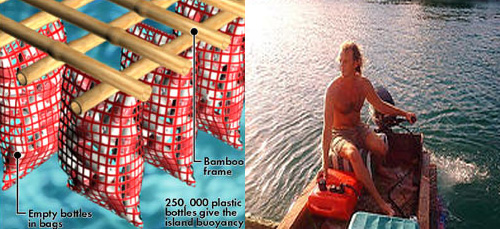
Not really my cup of tea really, I'm not into the PR side of things, I just want a floating, self-sufficient island, like what Richie Sowa's Spiral Island built in Mexico

I'd heard of this floating island thing before when researching the Lost Continent of Mu, but this Ecoble article is neat cos its got a diagram of how the plastic bottles he uses are assembled.

I reckon if there's bottles floating in the North Pacific Gyre, then an island built there could accumulate it's own mass. According to the wikipedia page for Spiral Island
the roots of the mangroves growing on it, help hold it all together, so once you reach some large mass, it'll have its own self-propagating structural integrity.

Also, I wandered along to the Reprap website earlier today. A Reprap machine is like a cheap 3D printer that prints out solid parts from plastic and can self-replicate about 60% of its own parts. If you get one of these, solar powered, sitting on an island, with a stream of nurdles drifting to it on the currents, you could get it to churn out its own plastic bottles.

Tuesday, 3 March 2009

Postcards from the lost continent

Via TreeHugger we find this video of a chap called Charles Moore doing a TEd lecture about plastic waste and how it ends up at the North Pacific Gyre.


Now previously I've mentioned that it would be a prime location to build an artificial island with a plastic-to-oil plant on it and just let the raw manterial float in. And as Charles moore mention in his talk, it's too expensive for one country to filter the oceans, so as I suggested previously, farm it out to an army of World of Warcraft types controling radio controlled boats. Get them to build the thing, get them to scoot round filtering and collecting debris.

Wednesday, 28 January 2009

So much for driftwood dreams

Days have passed since I posted about my dreams and aspirations, the one about wanting to build my own floating island, somewhere bobbing about in the lost continent of discarded plastic in the North Pacific Gyre.

I'm not alone.

It seems this meme has spread far and wide, well, The Spectator warmly embracing the article in Wired
Friedman and his followers are not the first band of wide-eyed dreamers to want to build floating utopias. For decades, an assortment of romantics and whack jobs have fantasized about fleeing the oppressive strictures of modern government and creating a laissez-faire society on the high seas. Over the decades, they've tried everything from fortified sandbars to mammoth cruise ships. Nearly all have been disasters. But the would-be nation builders assembled here are not intimidated by that record of failure. After all, their plans are inspired by the ethos of the modern tech industry, where grand quixotic visions are as common as BlackBerrys, and they see their task not as a holy mission but as something like a startup. A couple of software engineers came up with an innovative concept, then outsourced it to a community and let the wisdom of the crowd improve on it. They scored financing from a top-tier venture capitalist and assembled a board of directors. They will be transparent, blogging their progress. If they fail—which, let's face it, is the most likely outcome—they will do so quickly, in time-honored Valley fashion. But if they succeed, they have one hell of an exit strategy.

From the looks of things, their plans are a bit more developed than my own, with heli-pads and floating support columns.

I think I'll stick with my plan of building my stead from marine debris and sargassum, I can use ghost nets to bind it all together. Might have to relocate to the North Atlantic Gyre rather than the Pacific, its closer to home.

Hmph, on reading the article and the youtube videos attached. I reckon for the pro's who don't want to make their island out of garbage, they'd be best off buying a handful of really big ships, like the ones clogging up Hong Kong, and lashing them together. Maybe welding them together, but aye, something that's alread built and seaworthy. It'll be good for a few years, but then when one of the middle ships springs a leak and sinks, you'll lose half of your island.