Showing posts with label carrier bags. Show all posts

Friday, 11 September 2009

Knitting project #12 - Knitting with carrier bags - the conclusion

Ye gads, it was months ago, the end of May when I started it, and admittedly I finished the thing a few weeks back and it's been collecting dust in my heap of detritus next to my desk, but I feel I ought to share it with you.

This is my bag knitted from carrier bags:-

I currently use it to store my knitting stuff. Sadly the handle isn't attached very well, I've looped it through itself on the green side so its pretty secure, but on the blue side, it going to come undo if ever I use the handle.

It looks nice though. Here's the view of one side.

And here's the view of the other side:-

The orange is Sainsburys carrier bag, and the white is Tescos. For the noisy side I just alternated between Sainsburys and Tescos when making the yarn (as documented in the other blogpost), for the expanses of orange and white, well, you can figure out what I did there. I just never had large quantities of each colour available at any one time.

The blue and green handle and edges were made using bags from the corner shop, at some point in the last three months they changed from green to blue, the blue is slightly thinner than the green and so makes a weaker 'yarn'. Ah weel.

Its surprisingly stretchy and springy, but I wouldn't want to try making clothes out of carrier bags, and I reckon if it ever gets wet, it'll start growing fungus or something.

My next knitting project is a pink scarf for my attractive young ladyfriend, photos coming soon.

Wednesday, 27 May 2009

Knitting project #12 - Knitting with carrier bags

I am no stranger to carrier bag knitting, but past attempted have all involved tying whole bags together, which is adequate for making hammocks or rugs, but not so good for more conventional knitting. So other techniques are required.

Here's my step by step guide to knitting with plastic carrier bags.

Knitting project #12 - Conventional knitting with carrier bags

I use ones from Sainsburys, they say on that to reuse them, I am. They also say there are made from 50% recycled material. Whatever I knit will be from 100% recycled material.

Knitting project #12 - Conventional knitting with carrier bags

To turn them into 'yarn' first pull them through your hands to make them crumpled into long thin things, handles at one end, cul-de-sac at the other.

Knitting project #12 - Conventional knitting with carrier bags

Now use scissors to cut them widthways into 1 incg chunks to make lots of crumpled rings. You can chuck away the cul-de-sac end and the handles end. I can't think of any use for these bits.

Knitting project #12 - Conventional knitting with carrier bags

Now unfold all the rings that you've just cut. Some of them might have split, chuck away the broken ones. There's probably a really neat use for reject bits of cut up carrier bags, I dunno what it is.

Knitting project #12 - Conventional knitting with carrier bags

Now join all the loops together, where you loop one ring into another them pull it back through itself. You're smart, you can figure it out. Don't pull it too tight mind, its not going to be going anywhere so it doesn't need to be really small knot.

That's you done with the 'yarn', I guess you can roll it into a ball or something. And then its just a case of knitting as usual.

Knitting project #12 - Conventional knitting with carrier bags

I think I'm going to make a shopping bag of some description. I'm using 7mm needles bought for 20p from a charity shop in Burnham-on-Crouch, in the past I've bought very cheap knitting needles from Oxfam shops and very expensive needles from John Lewis, whatever meet your price point I guess.

For this shopping bag I casted on 40 stitches, its probably a wee bit too wide. I did a trial run of 16 stitches and that looked less than half of the size I wanted. Suck it and see, and try again. I'm doing that knitting thing where its just row after row of purls rather then knit one purl one.

Knitting project #12 - Conventional knitting with carrier bags

I'll let you know how I get on.

Friday, 24 April 2009

Return to the Lost Continent

I see from PopUrls that the Great Pacific Garbage patch is now twice the size of France.

The Telegraph article covers the usual ground about the sailing chap who heading home decided to drive his boat across the North Pacific Gyre, and how its all the fault of modern society using plastic.

Some interesting facts in the article from the Algalita Marine Research Foundation

Floating beneath the surface of the water, to a depth of 10 metres, was a multitude of small plastic flecks and particles, in many colours, swirling like snowflakes or fish food. An awful thought occurred to Moore and he started measuring the weight of plastic in the water compared to that of plankton. Plastic won, and it wasn't even close. 'We found six times more plastic than plankton, and this was just colossal,' he says. 'No one had any idea this was happening, or what it might mean for marine ecosystems, or even where all this stuff was coming from.'

So ended Moore's retirement. He turned his small volunteer environmental monitoring group into the Algalita Marine Research Foundation, enlisted scientists, launched public awareness campaigns and devoted all his considerable energies to exploring what would become known as the Great Pacific Garbage Patch and studying the broader problem of marine plastic pollution, which is accumulating in all the world's oceans.

The world's navies and commercial shipping fleets make a significant contribution, he discovered, throwing some 639,000 plastic containers overboard every day, along with their other litter. But after a few more years of sampling ocean water in the gyre and near the mouths of Los Angeles streams, and comparing notes with scientists in Japan and Britain, Moore concluded that 80 per cent of marine plastic was initially discarded on land, and the United Nations Environmental Programme agrees.

And then also in the Telegraph's article there's a bit of coverage of David de Rothschild's Plastiki, plastic boat project which the Guardian covered last week.
In a few weeks, the heir to one of the world's greatest fortunes, David de Rothschild, will set sail across the Pacific - in a boat, the Plastiki, made from plastic bottles and recycled waste. The aim of this extraordinary venture is simple: to focus attention on one of the world's strangest and most unpleasant environmental phenomena: the Great Pacific Garbage Patch, a rubbish-covered region of ocean, several hundred miles in diameter.
...

"I want the Plastiki to make a statement that it's our lack of reuse, uses and disposal that it is at fault, not the material itself," he said.

The eco-warrior has also designed his mission so that it copies key features of the voyage of the Kon-Tiki in which Thor Heyerdahl - a hero of de Rothschild - sailed across the Pacific to show how ancient South American Indians could have colonised Polynesia. As a result, de Rothschild originally set his launch date for 28 April - exactly 62 years to the day when Heyerdahl set out on his epic journey across the Pacific. However, teething problems with Plastiki recently forced him to postpone departure until later this summer.

Nevertheless, de Rothschild insists his craft will sail in the next few weeks and could one day revolutionise the use of recycled plastics in general and the design of boats in particular. Much will depend on how his craft behaves once the Plastiki expedition is under way, he admitted to the New Yorker recently. His craft should perform well, but could break up, he said.

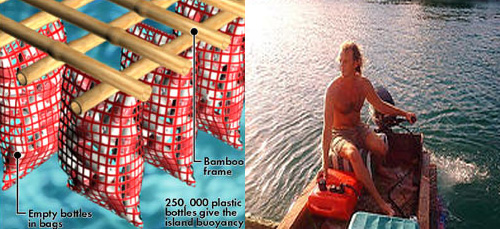
Not really my cup of tea really, I'm not into the PR side of things, I just want a floating, self-sufficient island, like what Richie Sowa's Spiral Island built in Mexico

I'd heard of this floating island thing before when researching the Lost Continent of Mu, but this Ecoble article is neat cos its got a diagram of how the plastic bottles he uses are assembled.

I reckon if there's bottles floating in the North Pacific Gyre, then an island built there could accumulate it's own mass. According to the wikipedia page for Spiral Island
the roots of the mangroves growing on it, help hold it all together, so once you reach some large mass, it'll have its own self-propagating structural integrity.

Also, I wandered along to the Reprap website earlier today. A Reprap machine is like a cheap 3D printer that prints out solid parts from plastic and can self-replicate about 60% of its own parts. If you get one of these, solar powered, sitting on an island, with a stream of nurdles drifting to it on the currents, you could get it to churn out its own plastic bottles.

Wednesday, 28 January 2009

So much for driftwood dreams

Days have passed since I posted about my dreams and aspirations, the one about wanting to build my own floating island, somewhere bobbing about in the lost continent of discarded plastic in the North Pacific Gyre.

I'm not alone.

It seems this meme has spread far and wide, well, The Spectator warmly embracing the article in Wired
Friedman and his followers are not the first band of wide-eyed dreamers to want to build floating utopias. For decades, an assortment of romantics and whack jobs have fantasized about fleeing the oppressive strictures of modern government and creating a laissez-faire society on the high seas. Over the decades, they've tried everything from fortified sandbars to mammoth cruise ships. Nearly all have been disasters. But the would-be nation builders assembled here are not intimidated by that record of failure. After all, their plans are inspired by the ethos of the modern tech industry, where grand quixotic visions are as common as BlackBerrys, and they see their task not as a holy mission but as something like a startup. A couple of software engineers came up with an innovative concept, then outsourced it to a community and let the wisdom of the crowd improve on it. They scored financing from a top-tier venture capitalist and assembled a board of directors. They will be transparent, blogging their progress. If they fail—which, let's face it, is the most likely outcome—they will do so quickly, in time-honored Valley fashion. But if they succeed, they have one hell of an exit strategy.

From the looks of things, their plans are a bit more developed than my own, with heli-pads and floating support columns.

I think I'll stick with my plan of building my stead from marine debris and sargassum, I can use ghost nets to bind it all together. Might have to relocate to the North Atlantic Gyre rather than the Pacific, its closer to home.

Hmph, on reading the article and the youtube videos attached. I reckon for the pro's who don't want to make their island out of garbage, they'd be best off buying a handful of really big ships, like the ones clogging up Hong Kong, and lashing them together. Maybe welding them together, but aye, something that's alread built and seaworthy. It'll be good for a few years, but then when one of the middle ships springs a leak and sinks, you'll lose half of your island.

Thursday, 8 January 2009

The Lost Continent of Mu

I know its wrong, but I love the idea of the Great Pacific Garbage Patch. Its this feature of the North Pacific Gyre where plastic waste and debris accumulates. All the plastic waste ejected into the ocean from Asia and North America, floating about on the ocean's currents, it all ends up bobbing about in the neuston of the gyre.

Like some great automatic refuse collection system, but without the garbage trucks. Sure its not free refuse collection cos the plastic ends up killing millions of sea creatures, but in terms of human involvement, its a passive system.

Apparently the area which the plastic waste collects in is about the size of Texas, its essentially a lost continent. But its not some solid piece of land, no one can walk on it, but its big and its got mass. Plastic barrels, cargo containers, plastic ducks, monofilament fishing line, all bobbing about.

And its there for the harvesting.

I've got this idea, well, a great stream of ideas.

Did you ever read that Treehugger article about some process to turn plastic into oil? Could they no just put one of those plants on an 'oil rig' in the middle of the gyre and let the plastic come to it. The operation could be self-sustaining, and just churn out crude oil.

It might take a load of investment to get off the ground, but hey, whilst we're on the way, lets have some fun and play some games.

Remember that Onion story about dolphins developing opposable thumbs?

What we need for the North Pacific Gyre is some thumb dolphins. No no, not live mammal dolphins, but something cooked up before the folk who make things on Robot Wars. I want a radio-controlled boaty thing with a robot arm or two on it, with opposable thumbs.

Not just radio controlled, but ethernet controlled. Controlled remotely over the world wide web, so some geek in his bedroom thousands of miles away can be controlling a wee thumb dolphin as it cruises about the gyre looking for large lumps of plastic, then dragging them to other large bits of plastic and sticking them together.

The world already has thousands of folk playing World of Warcraft, running about fantasy worlds, solving quests. This would be the same thing, but not virtual, just remotely controlled.

Now the punter in his bedroom has got to be able to see what he's doing, so when he drives his boat abou the can see where he's going and when he manipulates his robot arms he can see what he's grabbing hold of. So your thumb dolphin needs two webcam eyes, for stereoscopic vision, and also cos we're playing water world of warcraft, the player could do with a third person camera angle, so how about a camera on a stick coming out of the back of the thumb dolphin. Kind of like Mark Owens' Avatar Machine. Actually, a few scouter boats with their own cameras on really long sticks would be neat, to give a wider view of the area your thumb dolphins are working on, that would be cool, and if they also house solar panels and recharging docks for the dolphins.

At fist I was thinking that these thumb dolphins could tie the plastic bits that the find together using nylon string, but thats gonna be really difficult with their little robot hands. So, maybe using epoxy glue that might be easier, or if its sunny, a big old magnifying glass to weld bits of plastic together.

Actually, sack that, why not all three, give the gaming punters a choice. Have different professions of thumb dolphins, some have glue, some have magnifying glasses, some have better developed robot arms for tying knots.

How about stepping up a level and have different races of thumb dolphins, with more specialisation.
  • Tugs - clunky tug boats for locating and pulling together large bits of plastic.
  • Winders - seek out the monofilament wire and wind it onto reels to be used by...
  • Tyers - who tie things together
  • Scrabblers - who climb over larger pieces
  • Lobbers - who chuck smaller bits of plastic onto larger bits.
What we're trying to do here is build up a larger and larger single mass of plastic, a floating island, which has just enough structural integrity to hold its own bobbing about in the middle of the ocean. We want one of these, built by remote control.

Sure there needs to be some kind of central plan rather than just a load of WoW players dicking around. So you have Quests for the players things like:-
  • "accumulate 5Kg of mass"
  • "secure the east side of the island"
  • "find 100m of filament!
  • "retrieve player 23 who's run out of power"

So at the moment its all wave and solar powered, maybe the first boat on site will have to be a power station.

I ought to be thinking about structural integrity, cos those waves and storms are going to tear this thing apart. Its a big hole in my thinking, I like to think that the landmass becomes so big that no storm will destroy it. Sure it bobs up and down with waves, and sure a storm will rip bits off it, but the army of thumb dolphins can stitch it back together. And if a hurricane tears the island in half, they can stitch that back together too.

I know you're just wondering about the effect of all this on the local wild life, but don't worry, the North Pacific Gyre is mostly a dead zone, cos of all that plastic. This also makes it an excellent candidate for ocean seeding. This is the process whereby iron filings or iron sulphate are dumped in an ocean, encouraging algae blooms, which then draw CO2 out of the atmosphere, then die off and sink in the ocean. It either sinks to the bottom where the CO2 is sequestrated or is eaten up by fishies encourage more fish-life in the area.

Hmph, these fish are going to be inedible cos of the plastic and will lead relatively short and unsatisfying lives.

Ooh, you know that thing with mercury poisoning, where it accumulates in plants or animals until it kills the animal, then some other larger animal like a human or a panda eats the dead animal and absorbs the mercury and then accumulates it until they too die. But ultimately you get a corpse with a concentration of mercury in it, rather than diluted mercury spread all over the shop. Does the same thing happen with plastic and aquatic life? Our thumb dolphins collect all the large bits of plastic and we leave it to the food chain, fish and birds to accumulate all the smaller bits until they die and we can sling them on our new plasticy compost heaps.

So five years down the line, after our army if internet WoW thumb dolphin pilots have created our lost continent of plastic, we're going to want folk to live there, subsidence crofters perhaps. But more likely the sort of human life you get developing on third world rubbish tips, forraging for stuff to sell. Its not much of a life, but its what we can expect at first, loading up ships with whatever they've salvaged from the gyre, living under the shadow of our plastic to crude oil rig that's arrived.

Ooh, back to that ocean seeding operation, remember before the Beijing Olympics there was all that problem with algae clogging up the Qingdao sailing area, can we encourage that to happen, and then use all the algae as fertilizer and compost for farm land on our island. Sure it'll stink for a a few years, but it seems like a quick way to build up organic landmass, so we can start farming operations.

I see grain being grown, and potatoes, some kind of genetically engineered salt-resistant variety, and chickens running about pecking at it.

How much area of solar panels do we need to run a desalination plant? We're going to have acres of inorganic land where no plants will grow for a while and it'll be perfect for solar panels I reckon.

Sunday, 23 November 2008

Carrier Bag knitting (second attempt)

Time to give up on this year's attempt at knitting a hammock out of carrier bags. It looked like a heap of rubbish in the corner of my room and was just tiny bit embarrassing.

I like the colours in this one, the green, orange and blue could have made a neat picture or something if I'd planned it better.

Then again, I never quite got the hang of doing pictures in knitting and I only ever started it to out-twee the crafty ladies on bowlie.

Here's last year's attempt for comparison
knitting project #8
Last year's was longer, and I think I still remembered how to knit and pearl in alternative lines, this time round, that knowledge had been lost.

Anyhoo, I'm going to consign this one to the bin now unless someone makes and offer for it. I'll accept anything from my Amazon Wishlist.