Yesterday there were news stories about how the average UK consumer could save up £70 a year by changing bank accounts. Unbeknownst to me, the government had launched an initiative months ago, urging banks to allow customers to download their bank account transaction history in a standard format, namely MiData.
MiData is a comma separated value text file, you can open it in NotePad or Excel.
At the moment pretty much the only two things you can do with MiData is faff about with it in a spreadsheet, or upload it to GoCompare who will somehow process it and tell you which bank to change to.
I think GoCompare just looks how far into your overdraft you go and what the average account balance is, they then look at which bank accounts charge and pay what interest and other goodies and make recommendations. Their best recommendation for me was some Yorkshire bank who charge higher interest, but give you a £150 switching bonus, so less of a saving, more like a one-off free gift.
Anyhoo, there's so much more potential and risks involved with MiData.
Years ago I read online, possibly from Worstall, of an idea for banks (with the user's permission) to mine your data and automatically save you money by changing various service providers. For example say your current energy provider charges £30 a month, but other people in your area with the same household size are only paying £20 with a different provider, then the bank would change you over, saving you £10 a month. Presumably the bank would pocket half your saving for a limited period, but since you're paying less, who cares. No bank has done this, probably because of privacy laws.
With MiData, the ability to minedata is outwith your bank. But at the moment, there are no tools, no services. The main risk is that the MiData is just too personal.
When your bank lets you download the MiData, it is "anonymised" which by the looks of things means they remove any account numbers, and anything that look like an account number, just replacing it with asterisks. This only makes it anonymous in that you don't know personal account details, but that's not enough.
As an aside, I understand that some car insurers fit a black box that records your car's speed and time, so that they can insure you appropriately for how safely you drive. I read that some researchers can use this speed data alone to figure out where you are going each day. It takes a bit of datamunging, but presumably if you know the start point and the junction one way is 30 seconds drive and the junction the other way is 50 seconds drive. Any nefarious criminal can map your life just from speed measurements.
Similarly, from MiData, even without account details, it would be trivial to identify a person from their transactions.
For example, looking at petrol stations and supermarkets you can get a feel of where in the UK a person lives and works, they'd do their weekly shop within one or two miles of their house, their regular petrol fill up will be somewhere between their home and their place of work. Or even better their local train station or work train station will be within less than a mile. Occasionally they will be travel or petrol transactions further away, these would be holidays or visiting family members, traditionally some family members stay in the same place where they grew up. Likewise gift purchases will coincide with birthdays. An investigator can get themselves to Linkedin and Facebook and look for people who live in this area, work in another area and grew up some other specific place, and who's partner / parents have birthdays at whatever time of year.
There aren't many people who live in Chingford and work in Hertford, even fewer who grew up in Manchester.
Anyhoo, the cat is out of the bag. Like in the book The Light of Other Days by Stephen Baxter and Arthur C. Clarke, the post-millenial generation aren't going to give a crap about privacy, compared to the "benefits" of datamining. I imagine that security expert Bruce Schneier would be doing his nut in.
So, having identified a gap in the market, I have an awesome idea for a business that will turn me into the millionaire I've always dreamed of being.
First we create an app or website where people upload their MiData to and the site gives you a neat pie chart showing how you spend your money in categories like supermarket, petrol, Entertainment, etc, and histograms showing how much you spend on each category each month. Just like Quicken used to do before they discontinued the UK version.
Don't worry, your data has already been anonymised by the bank, the government said so.
Then once we have enough people's "anonymised" data, we add some data, like geographic locations for each supermarket, train station and petrol station and cafe, then we offer website users a fancy map showing where they spend. People will think its ace, and Bruce Schneier will start getting worried.
Then we do some more analysis showing how much people in different areas are spending on things, like the aforementioned energy providers, and we can start charging users for recommendations for where to switch to.
Then we can start telling people how many kids we think they have based on their data, and how many bedrooms their house has, recommendations of which car they should buy next, which phone and whether they are engaged in illegal activity, or what things they do that are abnormal.
The problem is that I don't have time to do this, neither have I the skills. Someone else will.
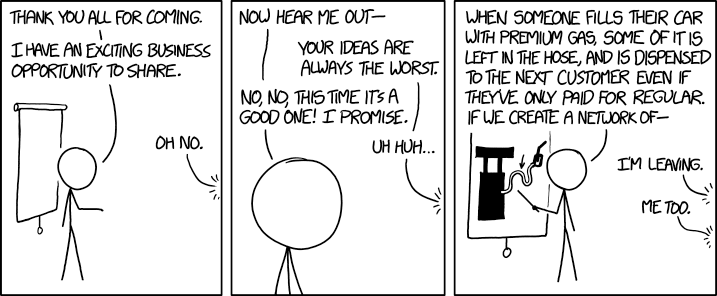
The government will at the same time as encouraging it and providing grants to organisations who can take advantage of the MiData, will also have very legitimate concerns about privacy.
There is a very faint trend on social media for young people, teenagers who have just received their first ever credit card, to post photos of said card and unwittingly give away the security number, so that nefarious people will use their details. Young people can be stupid. Lots of people are stupid and will do stupid things.
The government, and parents too, have a difficult job in weighing up the benefits of things like MiData and credit cards, with the risks. What protective measures will they put in place that are just as much of a ballache as the EU Cookie Directive, that makes you have to click on disclaimers on websites.
Imagine, if you will legislation that protects people's MiData privacy by putting in place some hardcore digital rights management, only allowing special government approved organisations and businesses to view and process, thus no small app developer could play with the data, only GoCompare and the banks and probably government departments, HM Revenue & Customs, and the police, probably hospitals too. Some DRM system that's so encrypted and heavyweight that developers often do raw datadumps, and leave hard disks and DVDs on trains.
This is what happens.
Showing posts with label finance. Show all posts
Friday, 23 October 2015
Saturday, 3 November 2012
On National Insurance and Child Benefit
There's recently been coverage in the media of a thing called 'The Living Wage', that is a wage upon which people can live comfortably, a somewhat higher wage than the current minimum wage. By a quirk of statistics, the Living Wage is within a few pence of what the take home amount of the minimum wage if it wasn't taxed. That is, if people on minimum wage didn't pay income tax, they'd be taking home the living wage.
Fiscally, I'm a big fan of raising the income tax threshold to £16,000 or so, enough to take the minimum wage earners out of the tax system. And then, with feelings of generousity, I'd raise the threshold to the median wage, so the poorest half of the UK paid no income tax, and the rest pay the rest of it, at whatever rate balances the books.
However, I'm not the chancellor, and I have doubts. There's the whole concept of National Insurance, which I still believe is an insurance scheme and not just a different name for tax. I feel that all earners, no matter what their income, should be paying national insurance, like putting away a little bit each pay day, for when they fall ill, or become unemployed or otherwise fall on hard times.
And here we land at the problem with Child Benefit. Within twelve months, those earning £50,000 or more will not receive Child Benefit. Whether or not this is fair depends entirely on whether that money comes from taxes or national insurance.
If its from the National Insurance Fund then it ought to be a universal benefit, paid for all children regardless of their parents' income. Imagine if you paid for insurance on your car or your house, and then when disaster strikes, the insurance company turned round and said, no, you can afford to repair or replace without the insurance money so we're not paying up. In which case, I imagine you would do your damnedest to ensure that the insurance company never received a penny from you.
But if Child Benefit is paid from tax, then fair enough, deprive the rich of it benefit, as they are paying for everyone else's services anyway, its part of the package, part of the deal you sign up to when choosing how closely you comply with a country's tax regime*. The tax rates vary regularly anyway so any gains or losses are transient rather than long term.
It appears that Child Benefit is not paid from the National Insurance Fund, and is administered by HM Revenue and Customs and so is paid from tax.
In order to hold views such as this I try to indulge tax avoidance as little as possible, I don't give money to charity, I don't use GiftAid, and I don't keep my savings in an ISA.
*Its widely believed that only the rich can take advantage of tax regimes in different countries to maximise their wealth. I believe this is untrue as I've worked for minimum wage in factories where the vast majority are workers who've travelled thousands of miles from far off lands to work for minimum wage and then send a proportion of their earnings back home to ensure their families have a higher quality of life. This is the same package as Sir Philip Green's wife living in Monaco receiving the benefits of the Arcadia group in the UK.
Fiscally, I'm a big fan of raising the income tax threshold to £16,000 or so, enough to take the minimum wage earners out of the tax system. And then, with feelings of generousity, I'd raise the threshold to the median wage, so the poorest half of the UK paid no income tax, and the rest pay the rest of it, at whatever rate balances the books.
However, I'm not the chancellor, and I have doubts. There's the whole concept of National Insurance, which I still believe is an insurance scheme and not just a different name for tax. I feel that all earners, no matter what their income, should be paying national insurance, like putting away a little bit each pay day, for when they fall ill, or become unemployed or otherwise fall on hard times.
And here we land at the problem with Child Benefit. Within twelve months, those earning £50,000 or more will not receive Child Benefit. Whether or not this is fair depends entirely on whether that money comes from taxes or national insurance.
If its from the National Insurance Fund then it ought to be a universal benefit, paid for all children regardless of their parents' income. Imagine if you paid for insurance on your car or your house, and then when disaster strikes, the insurance company turned round and said, no, you can afford to repair or replace without the insurance money so we're not paying up. In which case, I imagine you would do your damnedest to ensure that the insurance company never received a penny from you.
But if Child Benefit is paid from tax, then fair enough, deprive the rich of it benefit, as they are paying for everyone else's services anyway, its part of the package, part of the deal you sign up to when choosing how closely you comply with a country's tax regime*. The tax rates vary regularly anyway so any gains or losses are transient rather than long term.
It appears that Child Benefit is not paid from the National Insurance Fund, and is administered by HM Revenue and Customs and so is paid from tax.
In order to hold views such as this I try to indulge tax avoidance as little as possible, I don't give money to charity, I don't use GiftAid, and I don't keep my savings in an ISA.
*Its widely believed that only the rich can take advantage of tax regimes in different countries to maximise their wealth. I believe this is untrue as I've worked for minimum wage in factories where the vast majority are workers who've travelled thousands of miles from far off lands to work for minimum wage and then send a proportion of their earnings back home to ensure their families have a higher quality of life. This is the same package as Sir Philip Green's wife living in Monaco receiving the benefits of the Arcadia group in the UK.
Wednesday, 15 February 2012
Public Entertainment Licences in Scotland
There has now been a small pile of coverage in the blogsphere about the controversy of Public Entertainments Licences in Glasgow. Rays of light here and there.
Helen Shaddock brings us the response for Nicola Sturgeon MSP including this:-
Linn Labour gets all political about it, having a go at Nicola Sturgeon MSP for clarifying the Scottish parliament's position in the face of Glasgow City Council's warning about the repercussion of the change in legislation. Somewhere along the line there was a miscommunication, a fine article on the subject in The Firm explains that
There's a neat letter in The Herald pointing out
The campaign is still going strong on Facebook, with useful titbits filtering through, Zara Gladman wrote to her MSP Bill Kidd, who's aide Alison wrote back, possibly having looked at my list of what other councils are doing:-
The latest actual news via The Herald
One thing that has been bugging me immensely throughout is the spelling of licence, license, licencing, licensing?
Another thing is the nagging suspicion that maybe its Glasgow City Council, The Highlands Council and West Lothian who are on the ball in changing their policies, and the other 29 councils will all be playing catch up in the coming months. What if the rest of Scotland still have this battle to face once the various councils's lawyers have finished reading the legislation and then decide to implement it all across the board to the letter.
The main angle of my charge is that Glasgow is being unique in its implementation, and all the other councils are well aware of the change in legislation, but have decided not to implement it, that they know its all optional and have opted not to do anything. But maybe I'm wrong, and the rest of Scotland's art scenes are in for a fight.
Helen Shaddock brings us the response for Nicola Sturgeon MSP including this:-
However, it is important to stress that the new law does not mean that local licensing authorities are required to insist on free-to-enter events having a Public Entertainment Licence. The discretion lies entirely with the local licensing authority - in this case Glasgow - to determine what types of events they licence. The public entertainment licence is a discretionary licence. It is for the local authority therefore to decide whether to licence public entertainment and if they do, what specific types of entertainment they wish to include.Via For Pete's Sake we learn that Glasgow music scene heavy-weights Belle and Sebastian have weighed in on twitter with the jaw-dropping put-down:-
As I understand it, there is nothing whatsoever in the law to prevent Glasgow from exempting all or certain categories of free to enter events from the requirement to have a public entertainment licence. Indeed they already have exemptions in place in relation to school halls, church halls, fetes and gala days and there is no reason why other events cannot be added to this list of exemptions.
Not cool GlasgowCC [City Council], not cool at all.Art Tokens wonders why there's no corresponding fuss about Edinburgh City Council who require exhibits to have licences, perhaps this is because their policy is for venues with paid entry. They don't seem to have changed their policy in line with the change in the law.
Linn Labour gets all political about it, having a go at Nicola Sturgeon MSP for clarifying the Scottish parliament's position in the face of Glasgow City Council's warning about the repercussion of the change in legislation. Somewhere along the line there was a miscommunication, a fine article on the subject in The Firm explains that
The licensing of public entertainment is an “optional” civic licence. This means it is a matter for each licensing authority to decide whether or not public entertainment events should require a licence, and secondly to decide what forms of entertainment are treated as “entertainment” for licensing purposes.Thus bitch-slapping Glasgow City Council, bang, right in the chops.
There's a neat letter in The Herald pointing out
In this year of the Queen's Diamond Jubilee, many people will be considering ways to publicly celebrate this event. How many organisers will be aware that free entry community events will now, according to the legislative briefing on Glasgow City Council's website, require a public entertainment licence?Which is a rather neat angle, outwith art galleries and popup gigs.
The campaign is still going strong on Facebook, with useful titbits filtering through, Zara Gladman wrote to her MSP Bill Kidd, who's aide Alison wrote back, possibly having looked at my list of what other councils are doing:-
...The interpretation of this and decision on what scale of event requires a license is up to local authorities, It doesn't appear that other local authorities are taking the same approach as Glasgow, which would tend to suggest that the problems... ...are of [Glasgow City] Council's making. There is nothing in the Act which would automatically penalise small scale free events...Yeah, take that GlasgowCC, in your face.
The latest actual news via The Herald
...a spokesman for the local authority said it will seek a temporary solution so that small art exhibitions will not require a licence.Perhaps like what West Lothian council have already done, instead of the boilerplate use of 'Exhibition' in the list of events affected, they specify
The move – a redefinition of the term exhibition, the council said – will represent immediate steps which help to protect Glasgow's art scene.
Exhibition of persons or performing animals.and don't refer to art galleries at all.
One thing that has been bugging me immensely throughout is the spelling of licence, license, licencing, licensing?
Another thing is the nagging suspicion that maybe its Glasgow City Council, The Highlands Council and West Lothian who are on the ball in changing their policies, and the other 29 councils will all be playing catch up in the coming months. What if the rest of Scotland still have this battle to face once the various councils's lawyers have finished reading the legislation and then decide to implement it all across the board to the letter.
The main angle of my charge is that Glasgow is being unique in its implementation, and all the other councils are well aware of the change in legislation, but have decided not to implement it, that they know its all optional and have opted not to do anything. But maybe I'm wrong, and the rest of Scotland's art scenes are in for a fight.
Tuesday, 10 May 2011
Shares and Stuff: My top tips
Its been a month since I started wading in the murky depths of buying shares, and to date I've made a loss of about £40. As I said before, I bought about £250's worth each of Royal Bank of Scotland(LON:RBS), Kenmare (LON:KMR) and Halfords (LON:HFD) shares
The other week I sold the RBS and Kenmare cos they were looking shite. The taxpayer subsidized banking sector is doing down the swannie, with Lloyds giving up on some court case and now having to set aside £3billion to pay as compensation to folk who they'd mis-sold insurance to. Bear in mind that Lloyds don't have £3billion, its all taxpayers money, they're just moving it from one bunch of taxpayers to another. RBS will have to do the same. They're all just a load of shite. And Kenmare, they announced that all was going well and the prices of their products is going up, but that didn't affect their share price. So both RBS and Kenmare are about 42p a share now, compared to the 45p I bought them at.
Halfords is a bit of a success story, if only I'd just bought shares in Halfords. They're up about 11% in the month I've had them, so that's earned me back the commission fee and then some. I'm going to keep hold of Halfords for the summer.

But could I be doing better?
Sure, the housing market. I'm not quite in a position to but a house right now, I still need to make a my fortune with shares, but housing is where its at. Take a look at RightMove, the property website (LON:RMV) and Savills, the estate agents and property management people (LON:SVS). They've done pretty well over the past month compared to my benchmark Halfords.

And check out the past six months. Yeah, I think RightMove is my next big investment opportunity for shares and stuff. Over the past twelve months they've gone up 59%. Compare that to 3.3% return you'd get for a decent ISA, your money could be earning twenty times as much if you want to take the risk.
The other week I sold the RBS and Kenmare cos they were looking shite. The taxpayer subsidized banking sector is doing down the swannie, with Lloyds giving up on some court case and now having to set aside £3billion to pay as compensation to folk who they'd mis-sold insurance to. Bear in mind that Lloyds don't have £3billion, its all taxpayers money, they're just moving it from one bunch of taxpayers to another. RBS will have to do the same. They're all just a load of shite. And Kenmare, they announced that all was going well and the prices of their products is going up, but that didn't affect their share price. So both RBS and Kenmare are about 42p a share now, compared to the 45p I bought them at.
Halfords is a bit of a success story, if only I'd just bought shares in Halfords. They're up about 11% in the month I've had them, so that's earned me back the commission fee and then some. I'm going to keep hold of Halfords for the summer.
But could I be doing better?
Sure, the housing market. I'm not quite in a position to but a house right now, I still need to make a my fortune with shares, but housing is where its at. Take a look at RightMove, the property website (LON:RMV) and Savills, the estate agents and property management people (LON:SVS). They've done pretty well over the past month compared to my benchmark Halfords.
And check out the past six months. Yeah, I think RightMove is my next big investment opportunity for shares and stuff. Over the past twelve months they've gone up 59%. Compare that to 3.3% return you'd get for a decent ISA, your money could be earning twenty times as much if you want to take the risk.
Sunday, 1 May 2011
Shares and Stuff: A brief introduction
Yeah, so right, cos I'm all grown up now, I thought I'd invest some of my wealth in the stock market, or slightly more specifically, buying shares.
It was a rather pleasant surprise to find that the HSBC, who I've banked with for a number of years, have a share investy account thing which is really easy to set up. Just a few clickety clicks and a patient wait for the paperwork to go through, and I have an InvestDirect sharedealing account. This would enable me to buy and sell shares.
Now all I had to do was find some share to buy.
I've found that the easiest way to find companies to invest in and to track share prices is with Google Finance. To start with you search for companies, it tells you the share price and similar companies. What you want to do is find companies that you think are going to do well.
A brief sojourne...
Twenty or so years ago my mum was getting into the buying shares game and asked my advice, I suggested a company called Virtuality Group Plc, who in the early nineties pioneered virtual reality arcade games. I thought, this is the company of the future, Mother, invest now.
How could they fail? I mean, c'mon, VIRTUAL REALITY!! Sadly, they didn't become the new Microsoft, the new Nintendo, Apple or Google. And as home computer processing power increased, their products became pretty much pointless.
Sorry Mother, you asked the wrong twelve year old for stock market advice.
This time round I thought a bit less imaginatively, Royal Bank of Scotland (LON:RBS), for their shares fell about 95% in the credit crunch and subsequent government bailout, from almost £7.00 to 19p a share. Imagine if you had £10,000 tied up in them in 2007, that would be worth about £300, after the crash. You'd be ruined. But my thinking is that the company is much undervalued now, sure they were a bit over-priced before the crash, but their low price now is more a symptom of investors not wanting to touch them with a barge pole rather than an honest valuation of the company. Get the shares now whilst they're cheap, and give them a year or two and I reckon you'd easily recoup.
Another company that caught my eye was Halfords (LON:HFD), the bike and car parts superstore. We are in a recession, everyone's skint, but we still need summer holidays and the sun is shining. So, instead of jetting off to Malaga, folk are going to be driving to Mallaig. If I'm right then in the middle of the summer Halfords is going to be booming, and I could make a profit.
A third company is Kenmare (LON:KMR), they mine in Mozambique, and since May 2010, their shares have more quadrupled, going from 9p to 40p. £10,000 invested this time last year would be £40,000. I reckon they haven't peaked yet, and once their new mine starts churning out whatever magic metals they can find, then the sky's the limit.
So, I've bought myself shares in all these companies, only £250 in each, and the £12.95 commission on each transaction. But, I hear you ask, where do I get this money from? Well, I'm skint, so this money has come out of my overdraft. Its magic money plucked out of the air. But that's okay, its only if their value falls that anyone loses money.
A week passed. I got scared that Royal Bank of Scotland was going to crash again so I sold my share in them at a loss and bought more in Kenmare.
That was probably a mistake too, they were doing their annual salary negotiations with the workforce in Mozambique, and the workers went on strike and shut the mine down.
No matter, the weather's been good and Halfords shares have gone up by about 10% since I bought them. Wehay!
It was a rather pleasant surprise to find that the HSBC, who I've banked with for a number of years, have a share investy account thing which is really easy to set up. Just a few clickety clicks and a patient wait for the paperwork to go through, and I have an InvestDirect sharedealing account. This would enable me to buy and sell shares.
Now all I had to do was find some share to buy.
I've found that the easiest way to find companies to invest in and to track share prices is with Google Finance. To start with you search for companies, it tells you the share price and similar companies. What you want to do is find companies that you think are going to do well.
A brief sojourne...
Twenty or so years ago my mum was getting into the buying shares game and asked my advice, I suggested a company called Virtuality Group Plc, who in the early nineties pioneered virtual reality arcade games. I thought, this is the company of the future, Mother, invest now.
How could they fail? I mean, c'mon, VIRTUAL REALITY!! Sadly, they didn't become the new Microsoft, the new Nintendo, Apple or Google. And as home computer processing power increased, their products became pretty much pointless.
Sorry Mother, you asked the wrong twelve year old for stock market advice.
This time round I thought a bit less imaginatively, Royal Bank of Scotland (LON:RBS), for their shares fell about 95% in the credit crunch and subsequent government bailout, from almost £7.00 to 19p a share. Imagine if you had £10,000 tied up in them in 2007, that would be worth about £300, after the crash. You'd be ruined. But my thinking is that the company is much undervalued now, sure they were a bit over-priced before the crash, but their low price now is more a symptom of investors not wanting to touch them with a barge pole rather than an honest valuation of the company. Get the shares now whilst they're cheap, and give them a year or two and I reckon you'd easily recoup.
Another company that caught my eye was Halfords (LON:HFD), the bike and car parts superstore. We are in a recession, everyone's skint, but we still need summer holidays and the sun is shining. So, instead of jetting off to Malaga, folk are going to be driving to Mallaig. If I'm right then in the middle of the summer Halfords is going to be booming, and I could make a profit.
A third company is Kenmare (LON:KMR), they mine in Mozambique, and since May 2010, their shares have more quadrupled, going from 9p to 40p. £10,000 invested this time last year would be £40,000. I reckon they haven't peaked yet, and once their new mine starts churning out whatever magic metals they can find, then the sky's the limit.
So, I've bought myself shares in all these companies, only £250 in each, and the £12.95 commission on each transaction. But, I hear you ask, where do I get this money from? Well, I'm skint, so this money has come out of my overdraft. Its magic money plucked out of the air. But that's okay, its only if their value falls that anyone loses money.
A week passed. I got scared that Royal Bank of Scotland was going to crash again so I sold my share in them at a loss and bought more in Kenmare.
That was probably a mistake too, they were doing their annual salary negotiations with the workforce in Mozambique, and the workers went on strike and shut the mine down.
No matter, the weather's been good and Halfords shares have gone up by about 10% since I bought them. Wehay!
Subscribe to:
Posts (Atom)

